
FAQ
What is nuclear medicine?
- Nuclear medicine is a field that differs somewhat from X-rays or magnetic resonance imaging. It is not only interested in how an organ looks, but mainly in how it functions. This is sometimes much more important – for example, in the case of the heart, bones or thyroid gland. Doctors use a small amount of radioactive material for this purpose, which is distributed in the body exactly where it is needed, and the device then shows how the organ is functioning.
Is the examination safe?
- Yes. Many people are unnecessarily frightened by the word "radioactivity". In reality, the amount of substance you receive is very small – the dose is usually lower than in a CT scan. In medicine, only procedures where the benefits clearly outweigh any risks are used. The examination will not harm you in any way; on the contrary, it will help doctors find out what is going on.
Does the examination hurt?
- The imaging itself does not hurt at all. The only thing you may feel is a small prick when the radiopharmaceutical is injected into your vein, similar to when someone takes your blood. Then you lie on the table while the camera quietly and calmly takes images. No pain, no noise, no pressure.
How long does the examination take?
- The imaging itself is relatively quick, usually between 20 and 60 minutes. But keep in mind that you will need to wait a while beforehand for the substance to reach its destination. Sometimes it's just a few minutes, other times it's an hour or two. Overall, you will usually be in the department for around two hours.
Can the examination be performed at the patient's request?
- Yes, but it always needs to be approved by a doctor. Radioactive substances are only used when the examination is really necessary.
How do I make an appointment?
- For most examinations, you will need a referral from your doctor. The staff will give you an appointment based on availability, and it is often possible to make an appointment by telephone.
Can I drive after the examination?
- Yes, you can. The radiopharmaceutical does not affect your senses or attention in any way. After the examination, you can get behind the wheel without any worries and continue with your normal routine.
Can I be around children and pregnant women after the examination?
- Yes, normal contact is safe. We only recommend that you avoid prolonged and close contact during the first day after the examination, such as holding a child in your arms for several hours. Short hugs or normal household contact are perfectly fine.
When will I get the results?
- After the examination, the images are reviewed by a specialist who evaluates them and writes a report. This report is sent to your attending physician, who will discuss the results with you. This usually takes a few days. If a quick evaluation is needed, the doctor will make sure it is done sooner.
Do I have to follow any special instructions after the examination?
- No, you can continue with your normal day. It is only recommended that you drink more fluids so that your body can eliminate the radiopharmaceutical more quickly. Otherwise, there are no restrictions.
Will I be radioactive after the examination?
- Yes, briefly, but to a completely safe extent. The radioactive substance breaks down and is excreted from the body quickly. After just a few hours, the amount is negligible.
Can I exercise after the examination?
- Yes, exercise is actually beneficial. Just remember to drink plenty of fluids to help your body eliminate the radiopharmaceutical more quickly.
Can I travel after the examination?
- Yes. However, it is good to know that some sensitive detectors at airports may briefly detect traces of the substance in your body. If you are planning to fly, inform the staff and you will receive a confirmation.
Will I feel dizzy or weak after the examination?
- No, neither the examination nor the administered substance cause these feelings. Most patients leave the department without any problems and continue with their normal day.
Can I go straight to work after the examination?
- Yes, without any problems. No rest or sick leave is necessary. Only if you have a physically demanding job is it recommended that you drink more after the examination to help eliminate the radiopharmaceutical.
Will I feel anything unusual in my body after the examination?
- No, you will not feel anything at all. The radiopharmaceutical does not affect your perception, mood or bodily functions. After the examination, you will feel exactly the same as before.
Can I drink alcohol after the examination?
- A small amount is fine, but water or tea is recommended. Alcohol does not affect the substance itself, but it can dehydrate the body, which slows down excretion.
Can I donate blood after the examination?
- Yes, but it is recommended to wait a few days for the radioactivity to be completely eliminated. Your doctor will provide you with accurate information based on the type of substance that was used.
Can I eat whatever I want after the examination?
- Yes. After the examination, you can eat and drink as you wish. It is only recommended that you drink more water to eliminate the substance more quickly.
How will I know when the substance has been eliminated from my body?
- Most of it is eliminated in your urine within 24 hours. Drinking plenty of fluids will speed up the process. After two days, there is practically no radioactivity left in your body.
Will I receive any recommendations after the examination?
- Yes, usually brief verbal or written recommendations. They summarise how to behave after the examination – mainly to drink more and, if necessary, limit contact with small children for a few hours. Nothing complicated.
Are allergic reactions possible?
- Allergies to radiopharmaceuticals are extremely rare. Only trace amounts of the substance are administered, which are quickly broken down. Most patients tolerate the examination without any problems.
What if I have diabetes?
- This is not a problem for most scintigraphies. It is only important to inform the staff what treatment you are taking and when you last ate. They will then tell you whether a slight adjustment to the preparation is necessary.
Will I be radioactive after the examination?
- Yes, briefly, but to a completely safe extent. The radioactive substance breaks down quickly in the body and is excreted. After a few hours, its amount is negligible.
Can the examination be performed on pregnant women?
- During pregnancy, the examination is only performed when absolutely necessary. If you think you may be pregnant, be sure to inform the staff in advance.
Is the examination safe if I have a pacemaker?
- No, it is not. Unlike magnetic resonance imaging, scintigraphy is safe even for patients with pacemakers and other implants.
Can the radioactivity harm me?
- No, the doses are very small. To give you an idea, you will receive a dose similar to that of flying across the ocean several times. It is safe and controlled.
Will the examination affect my medication?
- Most medications are not a problem. Only for some special examinations is it necessary to stop taking your medication for a short period of time. Your doctor will inform you about everything.
Can children also undergo the examination?
- Yes. Doses are adjusted for children's age and weight, so they are safe.
What if I am allergic to the contrast agent used in CT scans?
- That is not a problem at all. Radiopharmaceuticals have a completely different composition than CT contrast agents, and allergies are practically non-existent.
Can the examination damage my kidneys or liver?
- No, the dose is too small. The radiopharmaceutical is naturally broken down and excreted from the body.
Will I feel anything when the substance is administered?
- Most people only feel a slight prick when the needle is inserted. You will not feel the substance itself – it has no taste, smell or heat. You will feel completely normal after the injection.
Could I feel unwell after the examination?
- This is very unlikely. Radiopharmaceuticals do not cause nausea or other problems. If you do not feel well after the examination, it is more likely to be due to stress, fatigue or hunger. The staff will of course help you if you feel any nausea.
Will I feel dizzy or weak after the examination?
- No, neither the examination nor the administered substance cause these feelings. Most patients leave the department without any discomfort and continue with their normal day.
Will I feel anything unusual in my body after the examination?
- No, you will not feel anything at all. The radiopharmaceutical does not affect your perception, mood or bodily functions. After the examination, you will feel exactly the same as before.
Will the examination affect my fertility?
- No, the dose of radioactivity is so small that it has no effect on fertility or reproductive organs. You can rest assured.
How long does the radioactivity remain in the body?
- Usually, most of the substance is excreted within 24 hours, with the rest excreted within a few days. Your body breaks it down naturally through urine and stool.
Can I donate blood after the examination?
- Yes, but it is recommended to wait a few days for the radioactivity to be completely eliminated. Your doctor will provide you with accurate information depending on the type of substance that was used.
What if I am pregnant and do not know it?
- If you suspect you may be pregnant, be sure to tell the staff. In such cases, the examination is usually postponed or a different, safer method is chosen.
How often can I undergo the examination?
- As needed. If the examination is necessary, it can be repeated several times a year. The radiation dose is low, and doctors always weigh the benefits and risks.
How much radiation will I receive?
- The radiation dose depends on the type of examination, but it is comparable to a standard X-ray and often lower than a CT scan. Each examination is designed to minimise the dose while providing a high-quality image.
Can the examination cause cancer?
- No, the risk is extremely low. The doses used are so small that a person would have to undergo thousands of such examinations for it to have any impact. Moreover, the benefits of a correct diagnosis far outweigh the theoretical risk.
How do I know when the substance has left my body?
- Most of it is excreted in the urine within 24 hours. If you drink a lot, the process will be accelerated. After two days, there is practically no radioactivity left in the body.
Do you lie in a tunnel like during an MRI scan?
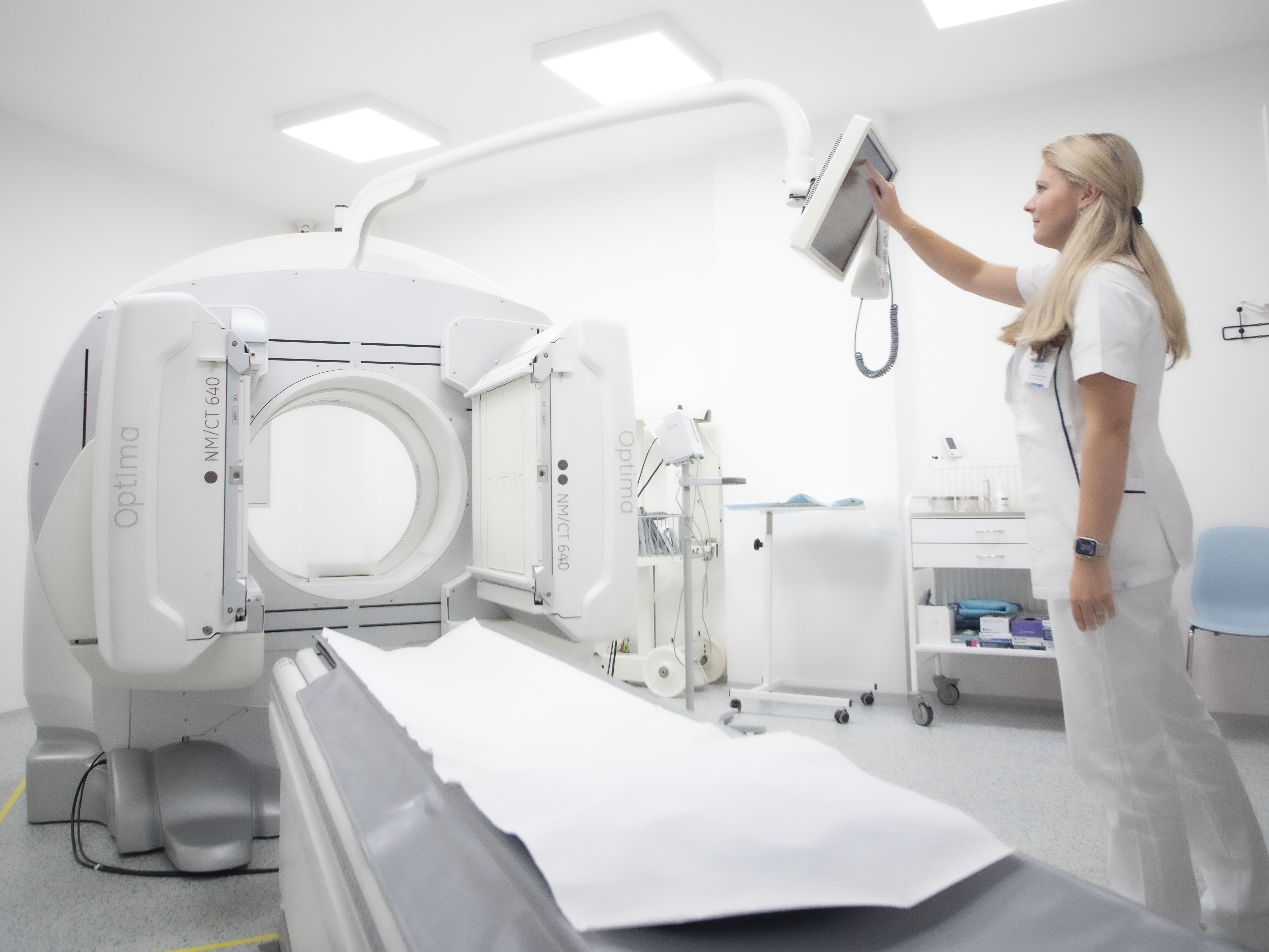
- No. The scintigraphy machine looks different – it has two movable arms that slowly rotate around you. It is not a narrow, noisy tunnel like an MRI scanner. The room is spacious and airy, and most people feel completely at ease.
Can a loved one accompany me?
- Certainly. Your companion can bring you, wait in the waiting room and take you home afterwards. However, they are not allowed into the examination room, as radioactive substances are used there and only staff and patients are permitted to enter.
What if I have claustrophobia?
- There is no need to worry. The equipment is designed to make the space feel open. If you know that you are afraid of enclosed spaces, tell the nurse in advance – the staff are experienced in dealing with this fear and will help you get through the examination.
Are allergic reactions possible?
- Allergies to radiopharmaceuticals are extremely rare. Only trace amounts of the substance are administered, and it is quickly broken down. Most patients tolerate the examination without any problems.
What if I have diabetes?
For most scintigraphies, this is not a problem. It is only important to inform the staff what treatment you are taking and when you last ate. They will then let you know if any minor adjustments to the preparation are necessary.
Is the examination okay if I have a pacemaker?
- No, it is not a problem. Unlike magnetic resonance imaging, scintigraphy is safe even for patients with pacemakers and other implants.
Could other problems be found besides the one I am being examined for?
- Yes, sometimes changes unrelated to the original problems are found during the examination. In such cases, the doctor will notify you and recommend further steps.
Why do I have to wait after the substance is administered?
- Because the radiopharmaceutical needs time to reach the organ being examined. Only then will the image be clear and understandable.
Can I fall asleep during the examination?
- Yes, and many patients take advantage of this – the examination is calm and quiet. Just do not move.
How is the radioactive substance administered into the body?
- Most often by injection into a vein – similar to a blood test. In some cases, you may drink or inhale it, depending on what is being examined. Each substance is modified to be completely safe for the body.
Will I feel anything when the substance is administered?
- Most people only feel a slight prick when the needle is inserted. You will not feel the substance itself – it has no taste, smell or warmth. You will feel completely normal after the administration.
What does the device used look like?
- The device is called a gamma camera and has the shape of a large circular head or two arms that move around the body. The entire examination takes place in a quiet room. The camera emits only a quiet motor sound, and the staff will communicate with you during the examination.
Do I have to lie completely still during the examination?
- Yes, it is important to remain as still as possible during the scan so that the image is not blurred. If you move, the device may repeat part of the scan. However, each scan usually only takes a few minutes and you can rest briefly between them.
What if I have back pain and cannot lie still for long?
- Please inform the nurse in advance. The staff can help you with pads, positioning or short breaks. The examination is always adapted to your abilities and comfort.
What if I need to use the toilet during the examination?
- Of course you can. If you have a longer waiting time after the substance is administered, it is advisable to go before the actual imaging. After the radiopharmaceutical is administered, it is advisable to go to the toilet more often, as this helps your body eliminate the substance more quickly.
What does the administered substance taste or smell like?
- Radiopharmaceuticals have no taste or smell. Some types are administered intravenously, others are drunk, but even in such cases they are tasteless.
Do I need to bring pyjamas or a change of clothes?
- No, the examination is performed in normal clothing. We will only ask you to remove any metal objects (belt, jewellery, watch), as they may interfere with the image. We recommend comfortable clothing without zips or metal accessories.
Why do I have to drink a lot of fluids?
- Because the radiopharmaceutical is excreted in the urine. Drinking more water or tea helps your body break down the substance more quickly. It is a simple and effective way to minimise the amount of time the substance remains in your body.
Can I listen to music during the examination?
- Yes, at some facilities. If it helps you relax, you can ask the staff if you can play music or bring headphones.
Can I talk or move during the examination?
- The short answer is: preferably not. Any movement can impair the quality of the image, so it is important to remain still. If you need to communicate anything, just tell the nurse – the examination can always be interrupted and resumed.
Do I need to fast?
- Most examinations are performed without the need for fasting – so you can eat and drink normally beforehand. Only for some examinations (e.g. liver and bile ducts) is it necessary to come on an empty stomach so that the results are not distorted. Don't worry, you will always receive clear instructions in advance so that you know what to do.
Can a loved one accompany me?
- Certainly. Your companion can bring you, wait in the waiting room and take you back home. However, they are not allowed in the examination room, as radioactive substances are used there and only staff and patients are allowed to enter.
Can the examination be performed on pregnant women?
- During pregnancy, the examination is only performed when absolutely necessary. If you think you might be pregnant, be sure to inform the staff in advance.
I am breastfeeding – what should I do?
- For some examinations, it is recommended to stop breastfeeding for 24 hours. After this time, everything is safe. Your doctor will explain the exact procedure to you.
Is hospitalisation necessary?
- No, the examination is outpatient. You can go home afterwards.
Do I need to stop taking my medication before the examination?
- In most cases, no. Only for some special examinations, such as those of the thyroid gland or heart, may it be necessary to stop taking certain medications for a short period of time. Your doctor will always inform you of this in advance.
What if I am overweight or have limited mobility?
- No problem. The equipment is designed for patients who are heavier or have limited mobility. If you have difficulty moving, the staff will help you lie down and get up.
How should I prepare myself mentally?
- There is nothing to be afraid of. The examination is quiet, calm and painless. The staff will explain everything to you in advance and will be in contact with you throughout the examination. If you need anything, just let them know.
