
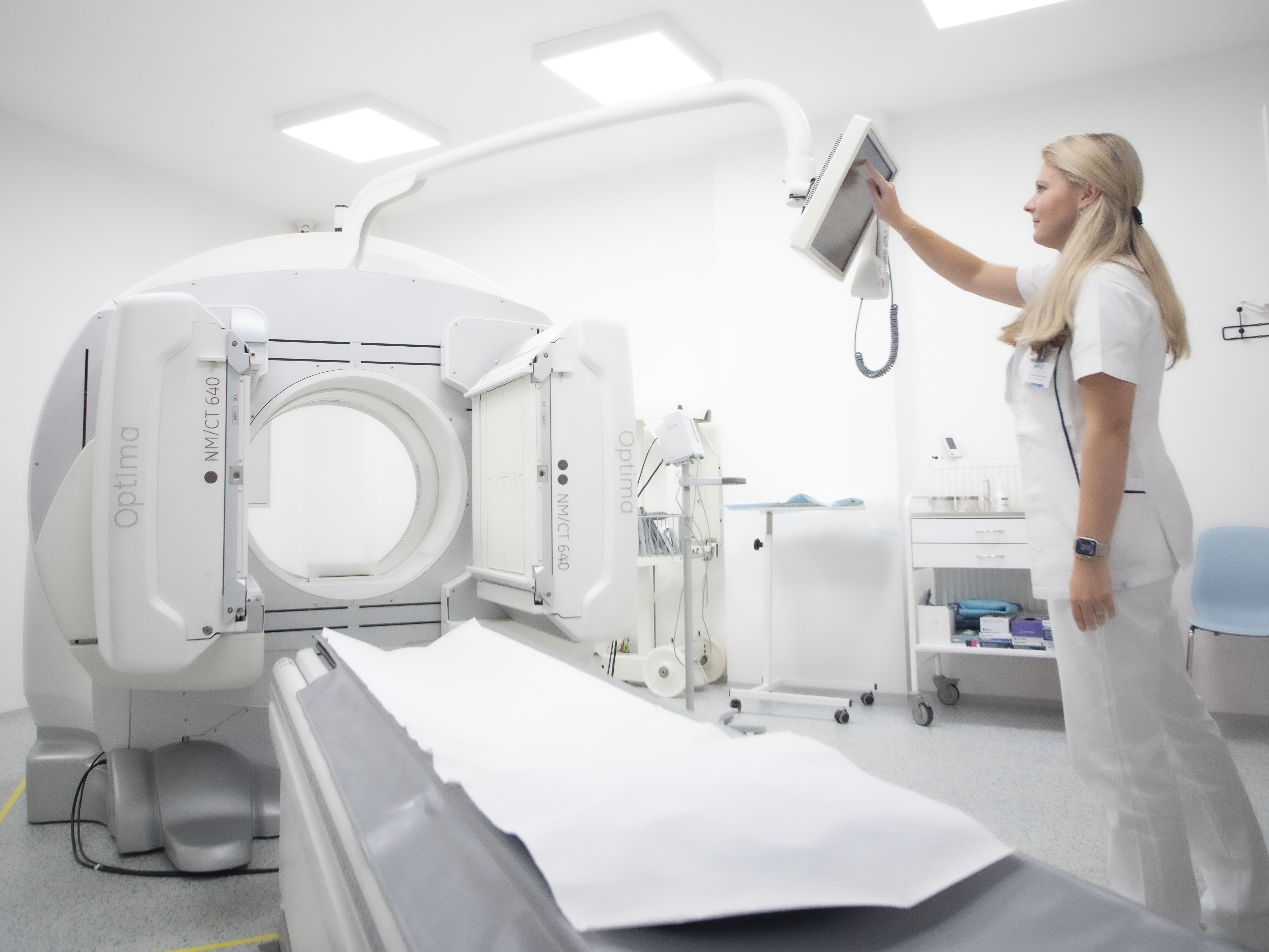
Lymphoscintigraphy
A gentle examination for a better understanding of limb swelling
What is lymphoscintigraphy?
Lymphoscintigraphy is a modern examination that shows doctors how your lymphatic system works. It monitors how lymph flows from the limbs to the lymph nodes and whether the pathways are clear.
This makes it possible to determine the cause of swelling in the legs or arms and to distinguish whether it is a problem with the lymphatic system or another cause (e.g. venous).
When is the examination used?
- For chronic swelling of the limbs.
- When a congenital disorder of the lymphatic pathways is suspected.
- After surgery, radiation treatment or injury.
- To check the effectiveness of treatment (physiotherapy, compression therapy, surgical procedures).
How is the examination performed?
- A small amount of radioactive substance is applied to the subcutaneous tissue in the area of the fingers or toes.
- This is followed by a short 2-minute scan of the injection site.
- This is followed by a 20-30 minute break, during which the patient rests on a bed, followed by a 20-minute scan.
- After the imaging, the patient goes for a 30-minute walk, followed by another 15 minutes of imaging.
- A special camera monitors how this substance travels through the lymphatic system.
- The doctor assesses whether the lymph flow is smooth, slowed down or blocked.
The examination usually takes 2 hours for the legs and 3 hours for the arms.
How to prepare
- No special preparation is necessary.
- After the examination, you can return to your normal activities.
- It is recommended that you drink plenty of fluids.
Is the examination safe?
Yes. The radiopharmaceutical used has a very low radiation dose and is quickly excreted from the body. The method is completely normal, painless and well tolerated.
Why choose us?
- Modern equipment
Individual and friendly approach
Experienced team of specialists
Cooperation with all health insurance companies
