
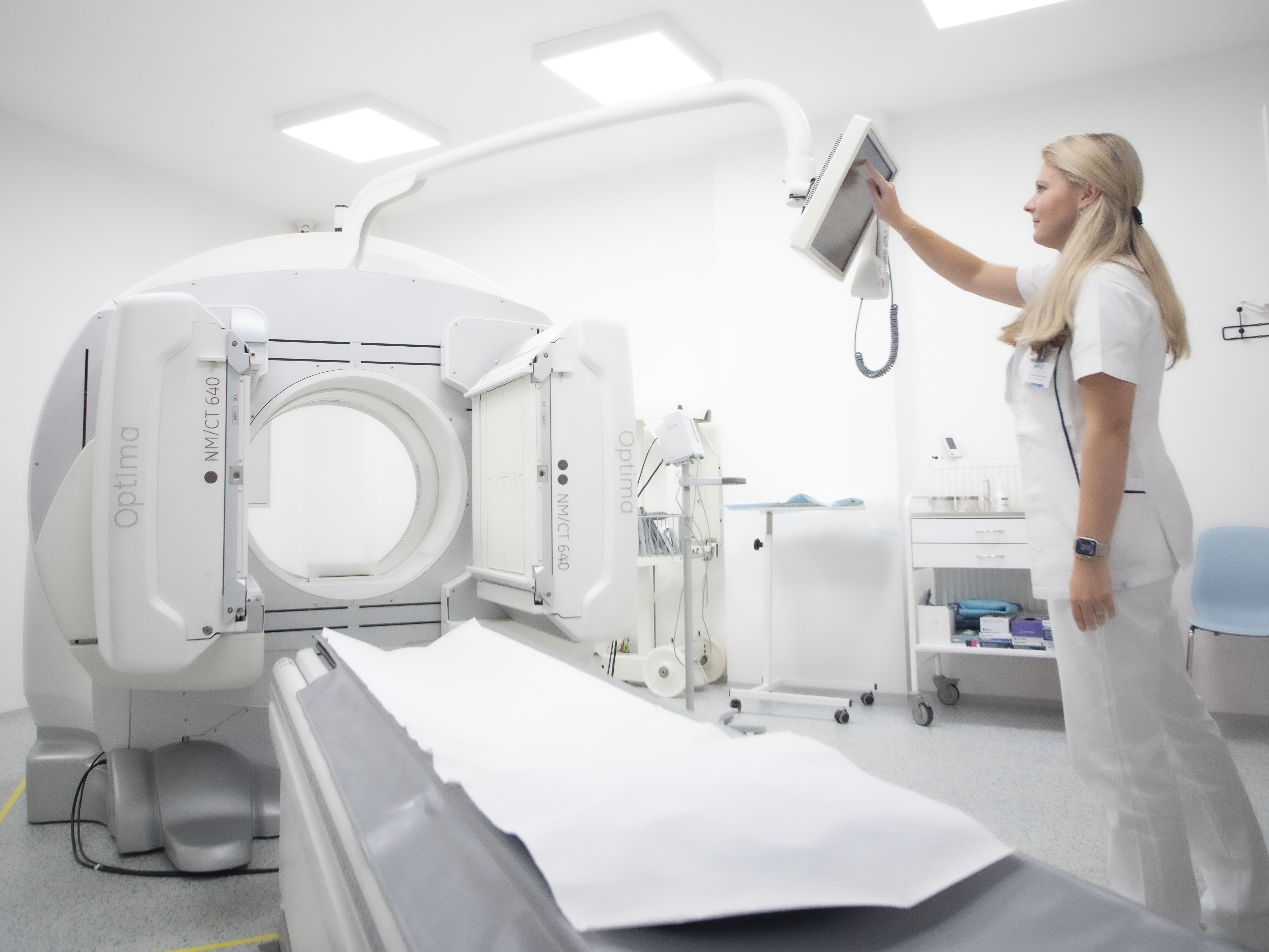
Scintigraphy of inflammation using leukocytes
A practical guide for referring physicians
Principle and method
Visualisation of leukocyte distribution enables targeted imaging of active inflammatory infiltration
Imaging is performed on the entire body or specifically on the affected area at time intervals (usually 3–6 hours after administration, sometimes supplemented by late images 20–24 hours later). SPECT/CT significantly increases localisation accuracy and specificity.
Main clinical indications
- Osteomyelitis
- acute and chronic, especially in long bones, the spine and complicated conditions,
- differentiation between infection and aseptic changes (e.g. after surgery).
- Endoprosthesis infection
- distinguishing between aseptic loosening of the implant and infection (especially in hip and knee replacements),
- method recommended in cases of unclear X-ray, CT or MRI results.
- Diabetic foot
- detection of skeletal infection (osteomyelitis) vs. soft tissue involvement.
- Soft tissue infections and abscesses
- deep infections of the abdomen, pelvis, retroperitoneum,
- postoperative abscesses, complications of surgical procedures.
- Inflammation in immunocompromised patients
- haematological patients, transplant patients, cancer patients.
Interpretation
- Positive finding: focal accumulation of leukocytes corresponding to the site of active inflammation.
- Negative finding: absence of pathological accumulation – infection can be practically ruled out.
Practical information for the referring physician
- Patient preparation: fasting
- Examination procedure:
- i.v. administration of labelled leukocytes,
- imaging usually 3–6 hours after administration, with late images added if necessary.
- Examination duration: imaging itself takes approx. 30–60 minutes.
- Radiation exposure: 5–7 mSv depending on the activity administered.
- Contraindications: pregnancy, breastfeeding,
Clinical scenarios and examples of use
- Patient with hip endoprosthesis – after several years of pain, X-ray and CT unclear. Scintigraphy shows focal accumulation around the endoprosthesis stem → confirmation of infection and indication for revision surgery.
- Diabetic foot – SPECT/CT used to differentiate infection in the metatarsal bones from soft tissue inflammation → essential for choosing the surgical procedure.
- Suspected spondylodiscitis – scintigraphy positive in the intervertebral disc and vertebral bodies → confirmation of infection and initiation of targeted antibiotic therapy.
Summary for practice
Scintigraphy with labelled leukocytes is:
- a modern and effective method for detecting inflammatory foci,
- particularly useful in osteomyelitis, endoprosthesis infections and diabetic foot,
- highly sensitive and specific, especially when combined with SPECT/CT.
Thanks to its properties, it is a valuable tool in the diagnosis of infectious complications that have a significant impact on treatment strategies in internal medicine, surgery, orthopaedics and infectious medicine.
