
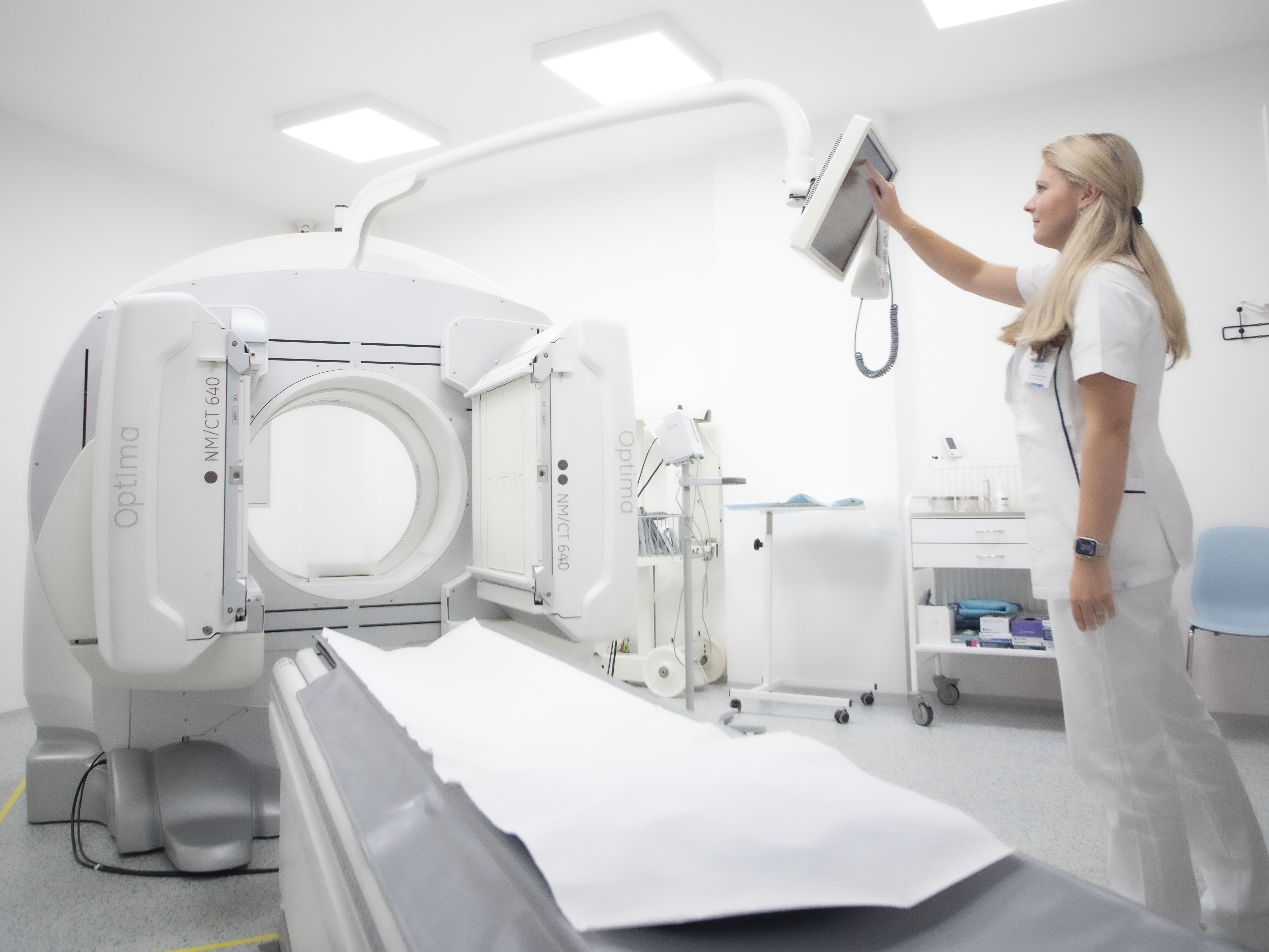
Parathyroid scintigraphy
A practical guide for referring physicians
Principle and method
Parathyroid scintigraphy is a nuclear medicine examination used to localise hyperfunctional tissue (adenoma, hyperplasia) in patients with confirmed hyperparathyroidism. The imaging principle is based on the different kinetics of radiopharmaceuticals in the parathyroid and thyroid glands.
Protocols used:
- Dual radionuclide protocol (201Tl + 99mTc-pertechnetate): Tl-201 accumulates in the parathyroid glands and thyroid gland, while Tc-99m images only the thyroid parenchyma. Subtracting both images allows the identification of hyperfunctional parathyroid glands.
- Single radionuclide protocol (99mTc-MIBI): MIBI is taken up in mitochondrial-rich tissue. A hyperfunctional parathyroid gland retains its activity longer than the surrounding thyroid gland, which allows detection by comparing early and late images.
Imaging is performed both planarly and using SPECT/CT, which increases the accuracy of localisation.
Main clinical indications
- Primary hyperparathyroidism – most often solitary adenoma.
- Secondary and tertiary hyperparathyroidism – hyperplasia in chronic renal disease.
- Reoperation in cases of hyperparathyroidism recurrence – localisation of residual or ectopic tissue.
- Suspected ectopic location of parathyroid glands – retrosternal, mediastinal, intrathyroidal.
Contraindications and patient preparation
- Relative contraindications: pregnancy, breastfeeding (breastfeeding must be interrupted for 48 hours; expressed milk must be discarded; close contact with the infant must be restricted).
- Preparation:
- discontinuation of thyroid medication (L-thyroxine 4 weeks, triiodothyronine 10 days before the examination),
- assessment of renal function and clinical condition of the patient.
Examination procedure
- Verification of identity and patient instruction – obtaining written consent.
- Administration of radiopharmaceutical:
- 201Tl chloride (80 MBq) + subsequently 99mTc pertechnetate (200 MBq) for the subtraction protocol,
- 99mTc-MIBI (usually 800 MBq) for the unambiguous protocol.
- Acquisition:
- planar images of the neck and upper mediastinum in anterior projection,
- SPECT/CT for precise localisation,
- for the MIBI protocol, early images (5–15 min) and late images (2–3 hours).
- Processing: image subtraction (Tl + Tc) or comparison of early vs. late phase (MIBI).
Interpretation and clinical significance
- Positive finding: focus with increased Tl accumulation or persistent MIBI accumulation in the parathyroid gland, inconsistent with the distribution of activity in the thyroid gland.
- Negative finding: absence of focal accumulation – does not rule out hyperparathyroidism (false negative in small adenomas, cystic lesions or diffuse hyperplasia).
- Ectopic localisation: evidence of foci outside the usual anatomical position – essential for surgical tactics.
Evaluation pitfalls:
- False positive findings – thyroid nodules, lymphadenopathy, inflammatory foci.
- False negative findings – small adenomas, hyperplasia, cystic changes.
Radiation exposure
- 201Tl chloride: effective dose approx. 0.22 mSv/MBq (higher exposure, limitations in paediatrics).
- 99mTc-pertechnetate: approx. 0.013 mSv/MBq.
- 99mTc-MIBI: approx. 0.009 mSv/MBq.
In practice, the 99mTc-MIBI protocol is therefore preferred, mainly due to its lower radiation exposure and simpler implementation.
Summary for practice
Parathyroid scintigraphy is:
- an essential method for localising hyperfunctional tissue in patients with hyperparathyroidism,
- enables accurate identification of adenoma or hyperplasia and detection of ectopic tissue,
- the method of choice prior to surgical treatment, especially in combination with sonography and CT/MRI,
- safe, with low radiation exposure (especially when using 99mTc-MIBI).
Thanks to its availability and high informative value, parathyroid scintigraphy remains an indispensable tool in modern endocrinology and nuclear medicine.
