
Thyroid scintigraphy (99mTc-pertechnetate)
A practical guide for referring physicians
Principle and method
Thyroid scintigraphy is a basic radionuclide method that allows imaging of the functional parenchyma and distribution of activity in the thyroid gland. After intravenous administration of 99mTc-pertechnetate, it is taken up by thyrocytes via the sodium-iodide symporter, but without incorporation into hormones. The distribution of the radiopharmaceutical therefore reflects the regional transport activity of the cells and provides an image of the function of individual areas of the gland.
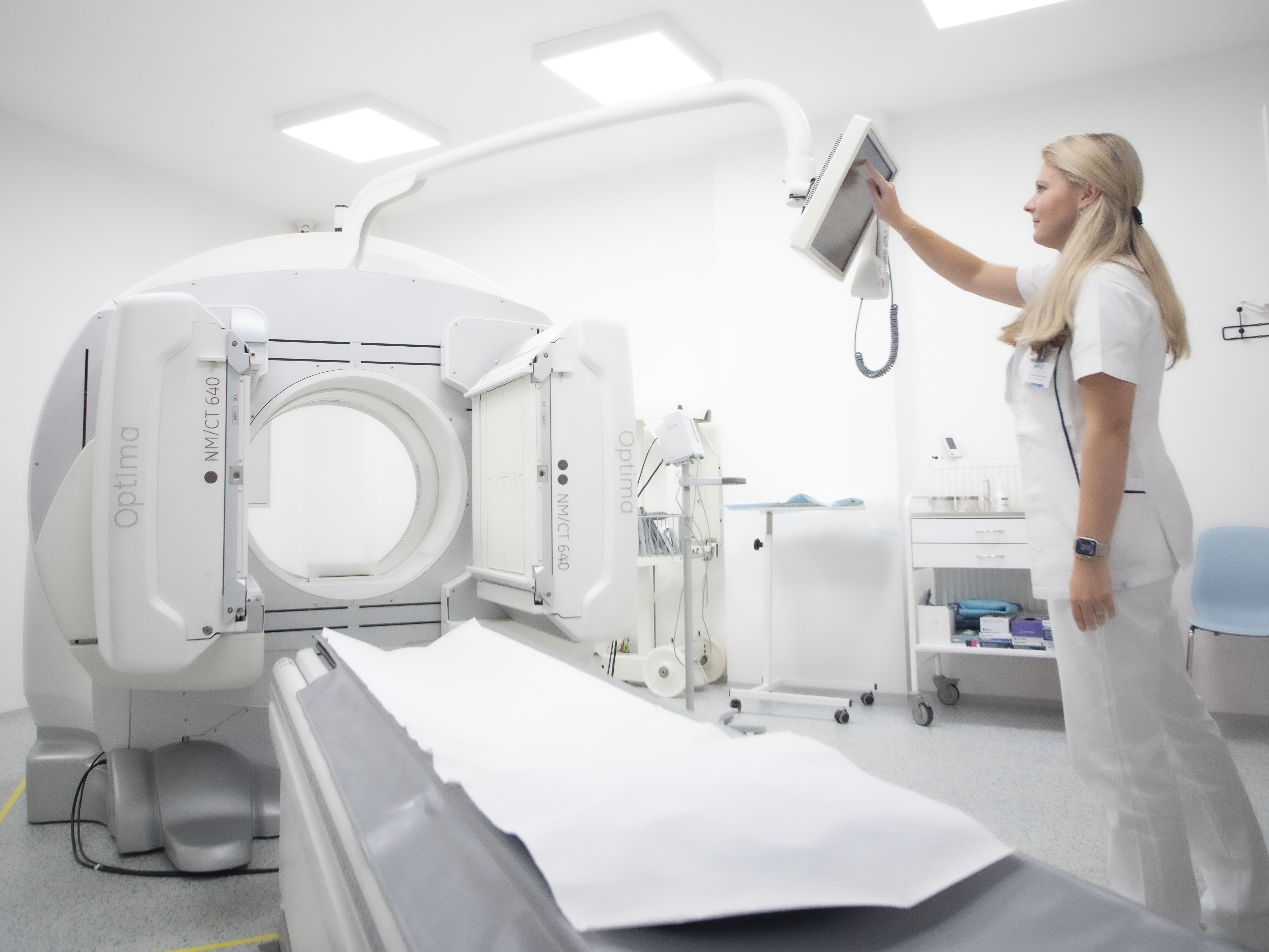
Scintigraphy is performed using a planar gamma camera, supplemented in indicated cases by SPECT/CT, which improves the localisation of foci and the differentiation of ectopic tissue. The examination has high sensitivity for both diffuse and focal functional disorders and is indispensable for the diagnosis of thyroid disorders.
Main clinical indications
- Toxic adenoma – evidence of a solitary hyperfunctional lesion with suppression of the surrounding parenchyma.
- Polynodular goitre – differentiation between hyperfunctional and hypofunctional nodules.
- Diffuse thyrotoxicosis (Graves' disease) – homogeneously increased accumulation.
- Hypothyroidism – low or no accumulation of radiopharmaceutical.
- Ectopic thyroid tissue – evidence of lingual, retrosternal or other ectopia.
- Retrosternal goitre – assessment of tissue extent and activity, supplement to CT/MR.
- Verification of the success of therapy (surgical or radioiodine).
Contraindications and patient preparation
- Relative contraindications: pregnancy, breastfeeding (breastfeeding must be interrupted for 12–24 hours depending on the dose, expressed milk must be discarded, contact with the infant must be restricted).
- Preparation:
- discontinuation of thyroid medication: levothyroxine for at least 10 days, triiodothyronine for 3 days,
- exclusion of inactive iodine administration for at least 4 weeks,
- after therapy with amiodarone, X-ray contrast agents or iodine antiseptics, wait up to 3 months.
Proper patient preparation is crucial – the presence of iodine in the body can significantly reduce the quality of the findings.
Examination procedure
- Administrative part – verification of patient identity, medical history with a focus on thyroid disorders, medication and contraindications. Obtaining informed consent.
- Administration of radiopharmaceutical – intravenous 99mTc-pertechnetate (usually 200 MBq in adult patients). Activity is recalculated according to weight.
- Imaging – begins approximately 15 minutes after administration.
- Standard planar images in the anterior projection, with the option of adding a marker in the jugular area for precise localisation.
- SPECT/CT: enables three-dimensional reconstruction, differentiation of ectopic tissue and more accurate quantification.
- Patient position – lying on their back, head slightly tilted back, neck supported.
Interpretation and clinical significance
- Normal findings: symmetrical distribution of activity in both lobes and isthmus.
- Toxic adenoma: a single focus of increased accumulation ("hot nodule") with suppression of surrounding tissue.
- Hypofunctional nodule: a focus of reduced accumulation ("cold nodule") – differential diagnosis must rule out malignancy.
- Graves' disease: diffusely increased activity, often with exophthalmos and typical clinical manifestations.
- Retrosternal goitre/ectopia: pathological accumulation outside the normal location of the thyroid gland.
Evaluation pitfalls:
- false negative findings with recent iodine or medication administration,
- false positive findings in inflammatory changes (thyroiditis).
Radiation exposure
- Effective dose: approx. 0.013 mSv/MBq.
- Highest exposure: upper part of the large intestine.
- A typical application of 200 MBq represents an effective dose of approximately 2.6 mSv.
Compared to CT scans, the exposure is low and the method is safe even for polymorbid patients.
Summary for practice
Thyroid scintigraphy with 99mTc-pertechnetate is:
- the basic method for assessing the function and distribution of thyroid tissue,
- indispensable in the differential diagnosis of thyroid disorders, nodules and goitres,
- a valuable supplement to sonography and laboratory tests,
- safe, accessible and low in radiation exposure.
Correct indication and interpretation of the findings contribute significantly to diagnosis and decision-making regarding further procedures in endocrinology and surgery.
