
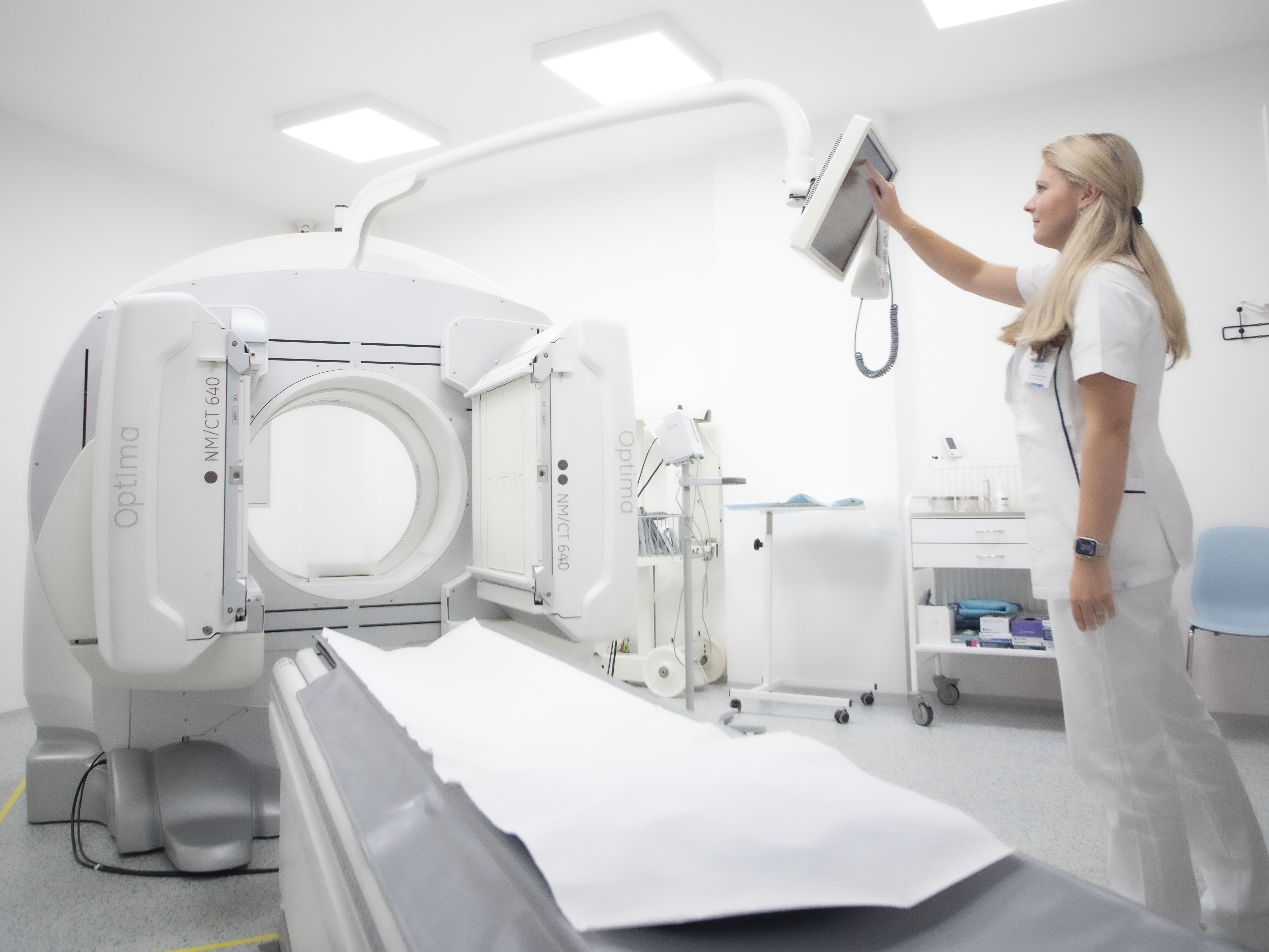
Cerebrovascular reserve (CVR) of the brain – SPECT with acetazolamide
Practical guide for referring physicians
Principle and purpose of the examination
Cerebrovascular reserve (CVR) expresses the ability of cerebral arteries to dilate during increased metabolic demands and ensure sufficient blood flow. Examination using SPECT perfusion scintigraphy in combination with pharmacological vasodilation with acetazolamide (ACZ) allows this reserve to be assessed and areas at risk of ischaemia to be identified.
The method is essential in planning revascularisation procedures (carotid endarterectomy, stenting, bypass), in selecting candidates for intervention, but also for monitoring the effectiveness of surgical or endovascular treatment. Additionally, it can help in the differential diagnosis of TIA, previous CMP, and in the evaluation of the vascular component of cognitive disorders.
Clinical indications
- Atherosclerotic stenosis or occlusion of the ACI (before and after the procedure, when bypass or stenting is indicated).
- TIA or ischaemic stroke outside the acute phase – assessment of the risk of recurrent ischaemia.
- Differentiation of vascular and primarily neuronal causes of cognitive deficit.
- Assessment of the efficacy of surgical or endovascular treatment in control studies.
Contraindications and safety of acetazolamide
- Absolute/relative contraindications: hypersensitivity to sulfonamides, recent stroke (<3 days), intracerebral haemorrhage, renal/hepatic insufficiency (caution), severe migraine history.
- Side effects: paraesthesia, tinnitus, dizziness, nausea, postural hypotension – usually transient.
- Legal framework: ACZ is used off-label, written patient instruction and informed consent are required.
Radiopharmaceuticals and dosage
- Radiopharmaceuticals: 99mTc-HMPAO (Ceretec) or 99mTc-ECD (Neurolite).
- Dosage in adults: 555–1110 MBq (usually 740 MBq).
- Paediatrics: according to the EANM paediatric dosage card (HMPAO min. 110 MBq).
- Imaging timing: ECD 30–60 min after administration; HMPAO 30–90 min; acquisition must be completed within 4 hours.
- Preparation quality: ECD purity >90%, HMPAO >80%, use of a freshly eluted generator.
Vasodilatory stress with acetazolamide
- Dose: 1000 mg i.v. slowly in adults, 14 mg/kg in children.
- Timing: maximum effect 15–20 min after administration – the radiopharmaceutical must be administered within this interval.
- Safety: continuous supervision, monitoring, secured intravenous access.
- Consent: required, off-label use.
Examination protocols
- Two-day protocol (preferred):
- Day 1: resting perfusion study.
- Day 2: administration of ACZ, RF application after 15–20 minutes, followed by acquisition.
- Advantage: no interference from residual activity, clear interpretation.
- One-day split-dose protocol:
- Resting injection of a smaller dose (370 MBq), followed by ACZ and a higher dose (≥740 MBq) for the stress phase.
- Requires sophisticated correction of residual activity, suitable for advanced workplaces.
- Alternative stress tests: hypercapnia (CO₂).
Interpretation
- Physiological response: global increase in perfusion after ACZ.
- Reduced CVR: insufficient increase in perfusion or absence of change in the monitored basin.
- Steal phenomenon: paradoxical decrease in perfusion in the ischaemically compromised area – a sign of exhausted autoregulation.
- Note: cut-off values vary according to methodology; intra-individual comparison with a normative database is preferred.
Safety precautions
- Before exercise: allergy history, basic monitoring.
- After ACZ: patient supervision, prevention of hypotension, resuscitation equipment available.
Documentation and output
- The request must include the clinical question (ACI stenosis/occlusion, revascularisation plan).
- Documentation: RF dose applied, ACZ dose, timing, acquisition parameters, corrections, data quality.
- Findings: description of rest and stress studies, quantification (ROI/VOI tables), conclusion on CVR.
- A signed informed consent form for ACZ administration is attached.
Summary for practice
Cerebrovascular reserve examination using SPECT with acetazolamide is:
- an essential method for assessing the vasodilatory capacity of cerebral vessels,
- key for deciding on surgical or endovascular revascularisation,
- useful in postoperative and long-term follow-up of patients after carotid interventions,
- a safe and accessible method, provided that a standardised protocol and patient monitoring are followed.
Proper indication and performance provide physicians with unique functional information that fundamentally influences the therapeutic strategy for patients with cerebrovascular diseases.
