
DaTScan (dopamine transporter scintigraphy)
A practical guide for referring physicians
Principle and method
DaTScan is a highly specialised nuclear medicine examination that enables in vivo imaging of dopamine transporters (DaT) in the striatum.
The radiopharmaceutical 123I-ioflupane is a selective ligand of the dopamine transporter expressed by presynaptic dopaminergic neurons. After intravenous administration, it binds specifically in the basal ganglia, where the density of dopamine transporters corresponds to the number of preserved dopaminergic terminals.
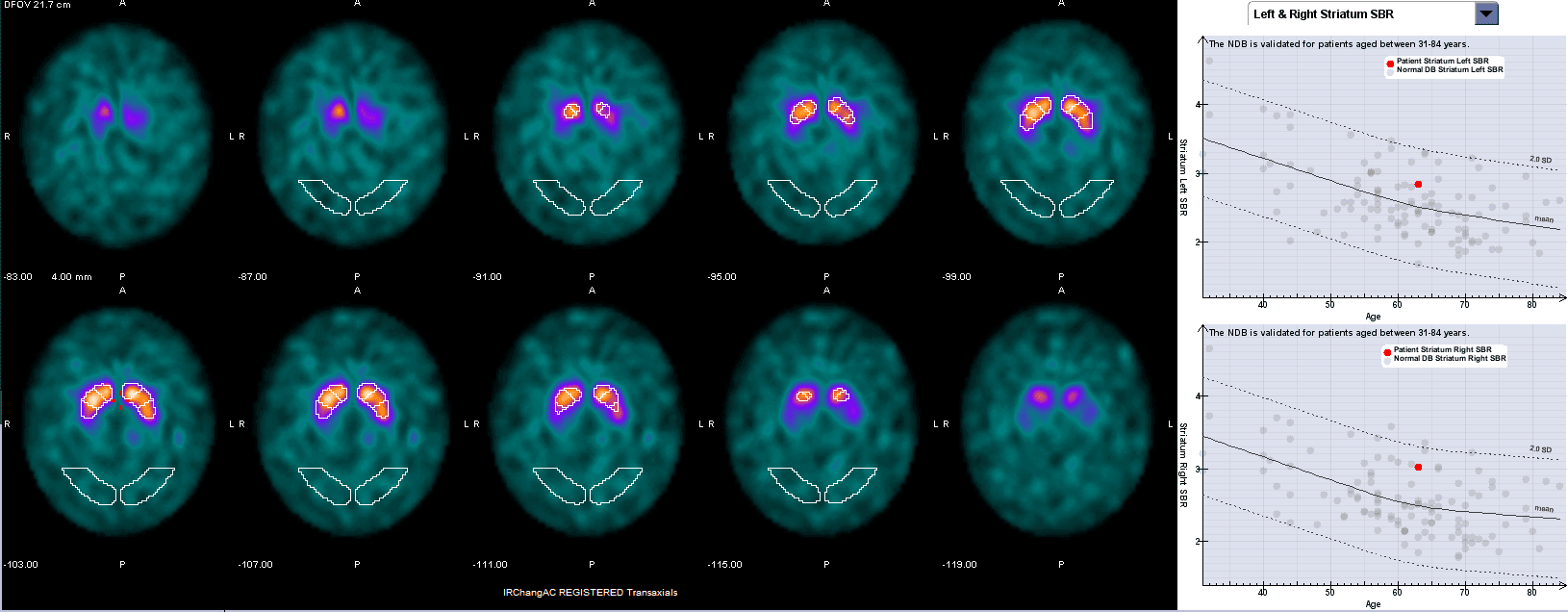
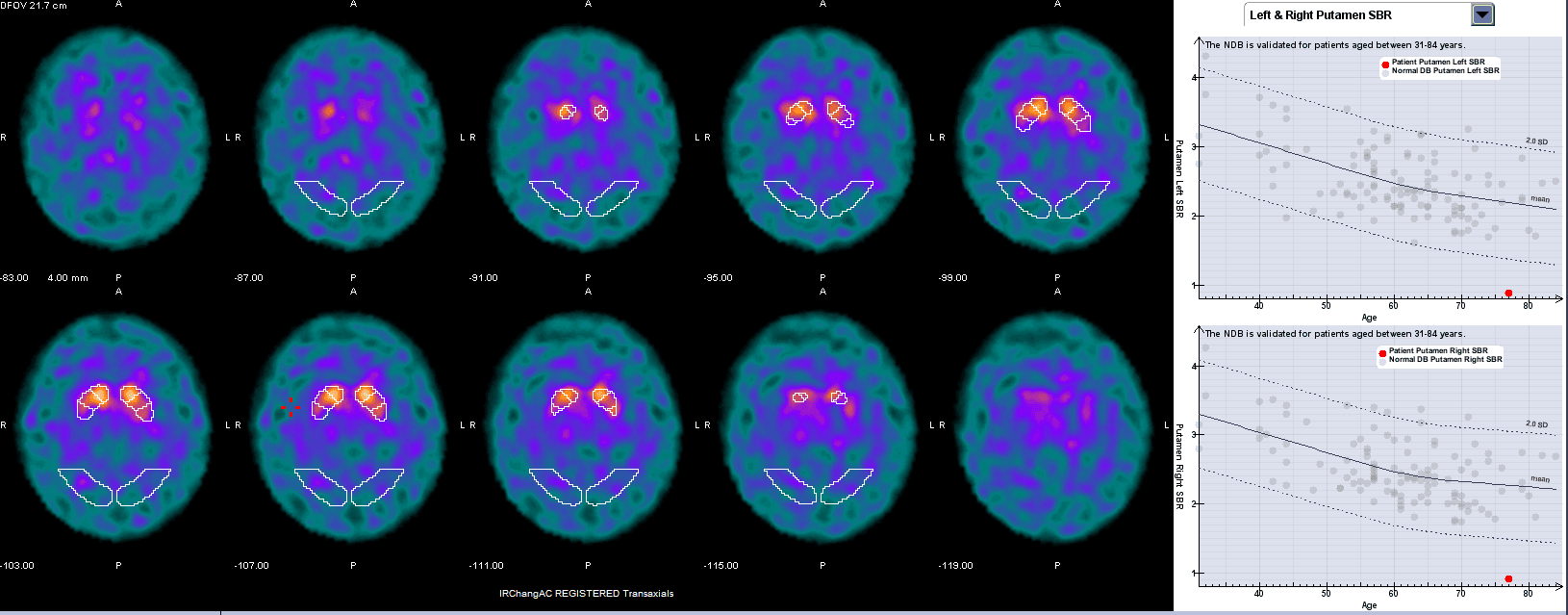
A reduction in the binding of 123I-ioflupane in the striatum is therefore an indirect indicator of neurodegeneration of the nigrostriatal pathway, typical of Parkinson's disease (PD) and other parkinsonian syndromes.
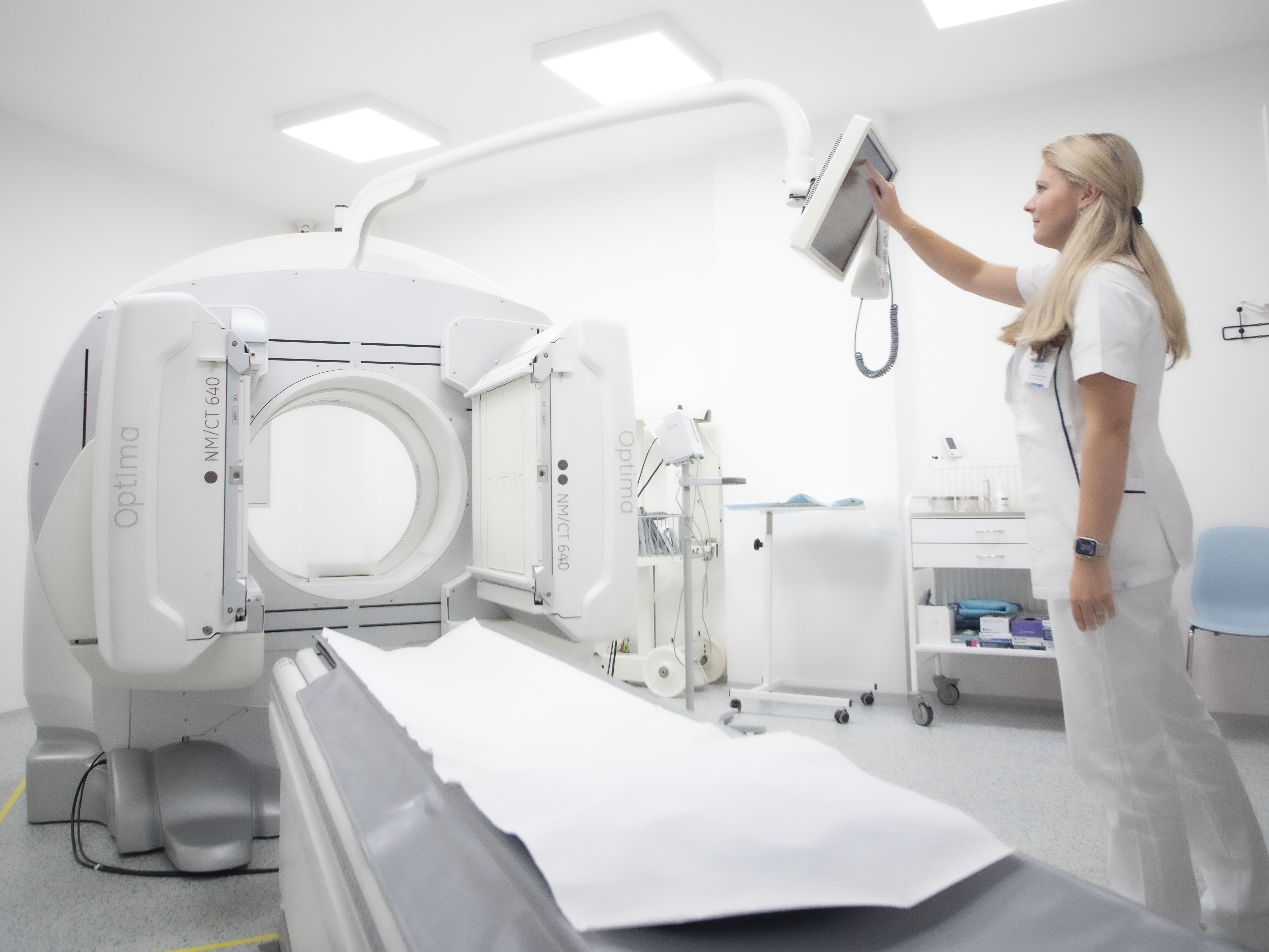
Imaging is performed 3–6 hours after administration of the radiopharmaceutical, usually using a SPECT camera. The result is an image of the distribution of dopamine transporters in the striatum, which can be evaluated both visually and quantitatively.
Main clinical indications
1. Differential diagnosis of Parkinson's syndromes
- Differentiation of idiopathic Parkinson's disease (reduced binding in the putamen/globus pallidus) from neuroleptic-induced or essential tremor (normal image).
- Essential in unclear clinical pictures, especially in the early stages of the disease.
2. Differentiation of atypical Parkinson's syndromes
- DaTScan shows reduced binding in MSA (multiple system atrophy), PSP (progressive supranuclear palsy) and CBD (corticobasal degeneration).
- However, the examination itself does not distinguish between these entities – they all show a pattern of reduced accumulation.
3. Differential diagnosis of dementia
- Dementia with Lewy bodies (DLB) – significant decrease in dopamine activity in the striatum.
- Alzheimer's disease (AD) – usually preserved DaT pattern, which is a significant distinguishing feature.
4. Other indications
- Monitoring the progression of neurodegeneration in clinical studies.
- Auxiliary examination in cases of suspected secondary parkinsonism.
Interpretation
Normal findings
- Symmetrical uptake of the radiopharmaceutical in the striatum.
Pathological findings
- Decreased or absent uptake, typically in the putamen, progressing to the caudate.
- Asymmetry corresponding to the clinical lateralisation of symptoms is common.
Practical information for the referring physician
- Patient preparation:
- Discontinuation of certain medications that interfere with uptake (e.g., amphetamines, bupropion, cocaine, SSRIs – as recommended).
- Duration of examination: administration of radiopharmaceutical, waiting time 3–6 hours, imaging approx. 30–45 minutes.
- Radiation exposure: approx. 4–5 mSv.
- Contraindications: pregnancy; breastfeeding (must be interrupted for 3 days).
Clinical examples
- Patient with upper limb tremor – clinically unclear whether it is Parkinson's disease or essential tremor. DaTScan shows asymmetric reduction in accumulation in the putamen → confirms neurodegenerative parkinsonism.
- Patient with dementia and Parkinson's symptoms – DaTScan shows diffuse decrease in activity in the striatum → supports diagnosis of dementia with Lewy bodies.
- Young patient with rigidity and dystonia – DaTScan normal → diagnosis of idiopathic Parkinson's disease ruled out, condition corresponds to secondary parkinsonism.
Summary for practice
DaTScan is:
- a highly sensitive method for detecting presynaptic dopaminergic neurodegeneration,
- essential for the differential diagnosis of Parkinson's disease, atypical Parkinson's syndromes and dementias,
- significant in clinical studies and routine practice, especially where the clinical picture is unclear,
- a method with a high clinical impact on diagnosis, prognosis and choice of therapy.
Correct indication and interpretation of DaTScan significantly helps neurologists to determine the diagnosis early and accurately and to optimise the treatment of patients with movement or cognitive disorders.
