
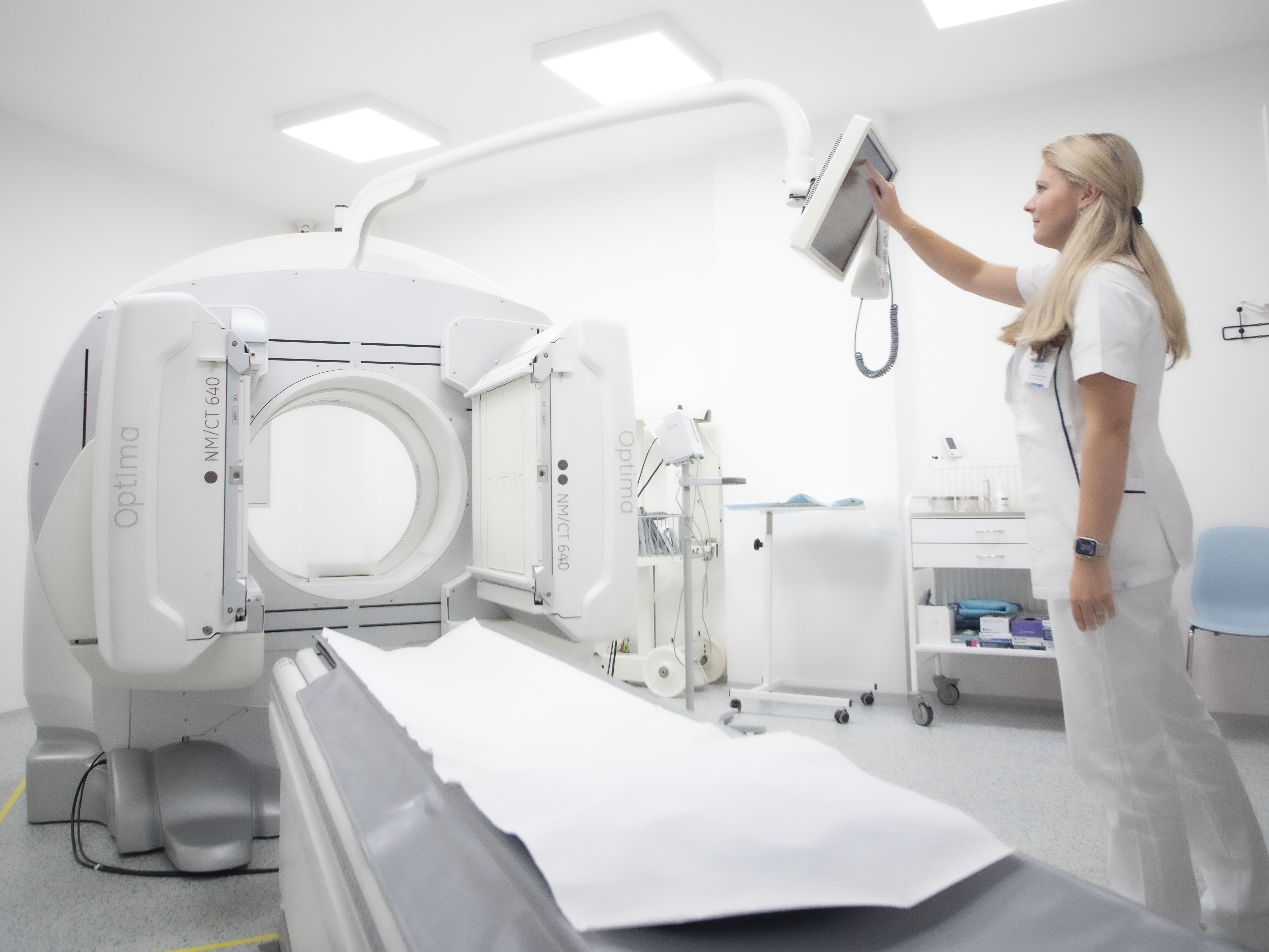
123I-mIBG examination – assessment of the heart's nerve supply
What is an mIBG scan?
The 123I-mIBG scan is a safe and painless method of assessing how well the heart's nerve supply, known as the sympathetic nervous system, is functioning. This nervous system helps to control the heartbeat, response to stress and overall heart function.
A small dose of the radioactive substance mIBG is used, which behaves similarly to noradrenaline (a neurotransmitter). Depending on how the substance is deposited in the heart, we can assess whether the nerve endings are healthy or damaged.
What is the examination used for?
The examination helps doctors with:
1) Heart disease
- assessing heart failure,
- assessing the risk of serious arrhythmias,
- monitoring the condition after a heart attack,
- supplementing information prior to treatment or device implantation (e.g. ICD, CRT).
2) Neurological diseases
- diagnosis of Parkinson's disease,
- distinguishing between Parkinson's disease and related diseases (MSA, PSP),
- confirmation of dementia with Lewy bodies.
The examination often helps to clarify the cause of symptoms such as balance disorders, dizziness, collapses, pressure fluctuations or fatigue.
How is the examination performed?
1. You arrive at the nuclear medicine department
- A doctor or nurse will go through a brief medical history with you.
- You will be given iodine drops or a tablet (to protect your thyroid gland).
2. Administration of mIBG
- A small dose of radioactive substance (123I-mIBG) will be administered into your vein.
- The injection is the same as a normal blood test.
3. Imaging with a gamma camera
The examination takes place in two stages:
- the first image is taken approximately 15–30 minutes after the injection,
- the second image 3–4 hours later.
Each scan takes only 5–10 minutes. You lie on your back, nothing hurts, nothing hums, nothing moves.
How to prepare for the examination?
- You can eat and drink; there is no need to fast.
- Regular medication is usually fine — with the exception of certain drugs that affect nerve endings (your doctor will give you precise instructions).
- Come in comfortable clothing.
- Pregnant women may not undergo the examination.
- Breastfeeding women are advised to stop breastfeeding for 24 hours.
Is the examination safe?
Yes. 123I-mIBG:
- contains a very low dose of radiation, lower than a standard CT scan,
- does not cause allergies, pain or discomfort,
- has no side effects,
- does not enter the metabolism of the heart or brain.
It is one of the safest examinations in nuclear medicine.
What exactly does the result mean?
The doctor evaluates how much mIBG has accumulated in the heart:
- Normal finding: nerve endings are functioning well.
- Reduced uptake: weakened function of the sympathetic nervous system of the heart.
- Significantly reduced: usually in Parkinson's disease, some types of dementia, or severe heart failure.
The result helps to determine the diagnosis, adjust treatment and estimate the risk of certain complications.
Benefits for the patient
- Painless, simple, safe
- Non-invasive (no probes or catheters)
- Helps identify the cause of symptoms
- Can significantly influence the treatment plan
- Often clarifies neurological diagnosis when other tests are inconclusive
Summary
The 123I-mIBG scan is a modern and sensitive method that can assess how well the nerve supply to your heart is functioning. It helps doctors determine the correct diagnosis, assess risks and set up the most appropriate treatment. It is safe, quick and painless.
