
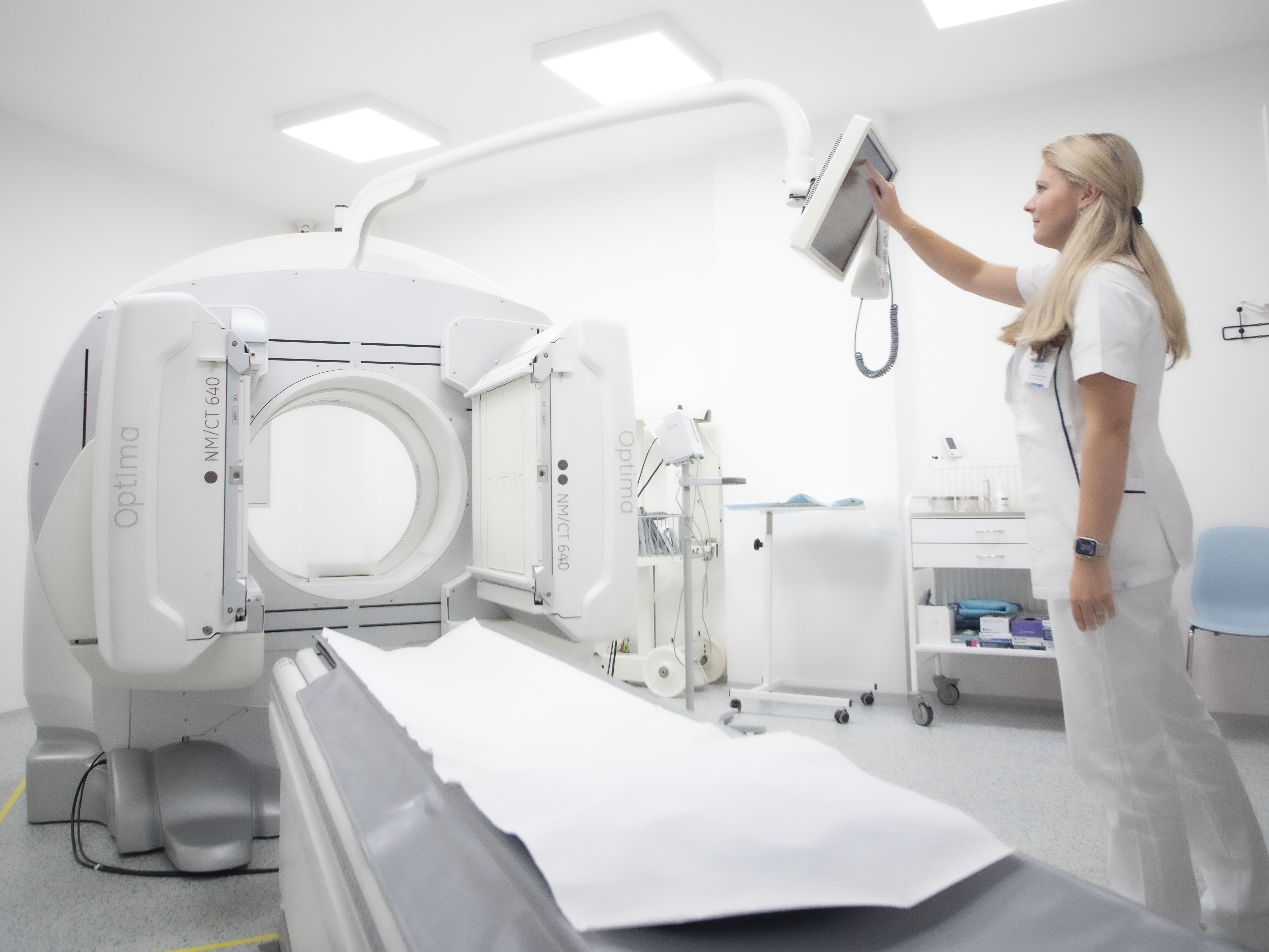
Tumour scintigraphy – Octreoscan (¹¹¹In-pentetreotide)
What kind of examination is this?
Octreoscan scintigraphy is a test that helps to determine whether there is a tumour in your body that has special proteins on its surface, known as somatostatin receptors. These receptors are often found in neuroendocrine tumours (NETs).
The examination uses a small amount of radioactive material that binds to these tumours and allows them to be visualised using a gamma camera.
When is the examination performed?
Your doctor may recommend Octreoscan, for example, if:
- suspicion of a neuroendocrine tumour,
- searching for the primary site if hormones are elevated but no tumour has been found,
- investigating the spread of the tumour (metastases),
- problems such as diarrhoea, hot flushes, fluctuations in blood pressure, fatigue,
- monitoring the effect of treatment.
Is the examination safe?
Yes — the examination is:
- painless,
- non-invasive,
- uses a very small amount of radioactivity,
- has almost no side effects.
The radioactive substance is gradually eliminated from the body naturally.
How should I prepare?
Medications
If you are taking somatostatin analogues (e.g. Sandostatin, Somatulín), tell your doctor.
These medicines usually need to be temporarily discontinued:
- short-term injections: 1–2 days in advance
- long-acting injections (LAR): approximately 4 weeks in advance
Everything will be arranged with your specialist.
Other instructions
- You do not need to fast.
- You may drink and eat normally.
- Drink plenty of fluids (water, tea).
- If you have trouble with constipation, you may be recommended a mild laxative.
Pregnancy and breastfeeding
- Pregnant women cannot undergo the examination.
- Breastfeeding must be interrupted for 2–3 days.
How does the examination work?
Day 1 – administration and first images
- You will receive a small dose of ¹¹¹In-pentetreotide via an intravenous injection.
- Usually after 4 hours, the first short scan with a gamma camera is performed (approx. 20–30 minutes).
Day 2 (sometimes Day 3) – second images
- You will come in for another scan, usually 24 hours after the injection.
- Sometimes an additional scan is performed after 48 hours.
- The imaging is again painless; you just lie still.
Total
- The scans themselves take several tens of minutes.
- Between the injection and the imaging, you can go home or take a walk.
What are they looking for in the images?
Doctors look to see if the radioactive substance has bound to any deposits. This helps to:
- find the tumour,
- determine its extent,
- check whether the treatment is working,
- decide whether PRRT treatment (e.g. Lutecium-177 DOTATATE) is appropriate.
After the examination
- It is recommended that you drink plenty of fluids to help eliminate the substance more quickly.
- You can return home and to work.
- Contact with other people is safe.
Summary
Octreoscan scintigraphy is a safe and very useful examination that helps doctors determine exactly where a neuroendocrine tumour is located and how it behaves. This allows them to prescribe the most effective treatment possible.
