
How modern quantification of transporters in the brain increases the accuracy of Parkinson's disease diagnosis
Why is diagnosing Parkinson's disease still challenging?
Parkinson's disease and other movement disorders are among the most common neurodegenerative diseases.
However, accurate diagnosis is often difficult, especially in the early stages when the clinical picture is unclear, asymmetrical, or overlaps with essential tremor or other movement disorders. The most common cause of movement disorders, especially hand tremors, difficulty walking and balance disorders, is a disorder of dopamine metabolism in the brain nuclei. Imaging of these nuclei using 123I ioflupane technical SPECT has become a key tool for imaging their integrity. It
is typically evaluated visually, which is reliable but can be:
- subjective,
- dependent on the physician's experience,
- difficult in borderline cases.
This is why DaTQUANT® was created — a programme that converts qualitative imaging into quantitative parameters, thereby increasing the accuracy, repeatability and objectivity of the diagnosis.
What is DaTQUANT®?
DaTQUANT® is GE Healthcare software designed for:
- automatic analysis of SPECT images of dopamine transporters (DaTSCAN)
- quantification of radionuclide uptake in brain nuclei
- comparison of results with an extensive age-normalised database
The software is integrated directly into the Xeleris system and uses algorithms for automatic:
- comparing the brain to a standard position
- detection of regions of interest
- calculation of SBR (specific binding ratio)
- comparison with healthy controls
The result is objective numerical information that complements visual assessment.
How does DaTQUANT work? Step-by-step principle
1️⃣ Automatic brain orientation
The software aligns the brain to a standard spatial orientation so that striatal structures are comparable to the reference atlas.
2️⃣ Automatic striatal segmentation
DaTQUANT identifies the following structures:
- caudate (head of the caudate nucleus) – left and right
- putamen (anterior and posterior)
The software thus includes up to 4 regions of interest, not just the whole.
3️⃣ Calculation of Specific Binding Ratio (SBR)
SBR = (activity in ROI – activity in reference area) / activity in reference area
The reference area is usually:
- occipital cortex
- cerebellum
4️⃣ Comparison with a database of healthy controls
The software provides:
- percentage by age
- graphical representation of decline
- asymmetry indicator
- values for individual parts of the striatum
5️⃣ Report generation
The output is visually clear:
- colour map of the brain
- SBR numbers
- progressive decline graph
- percentiles
The output can be easily attached to a medical report.
Why is quantification (DaTQUANT) such a big advantage?
1. It supports correct diagnosis
Especially in borderline or early findings.
E.g.:
- visually slightly reduced → quantification confirms a significant decrease
- visually normal → quantification can reveal asymmetry or a slight deficit
2. It helps distinguish Parkinson's disease from other disorders
- Parkinson's disease → typically a decrease in the posterior putamen
- Essential tremor → normal findings
- Dopamine-affecting drugs → may be selective decrease or normal image
- Atypical Parkinson's syndromes → other patterns of impairment
The combination of visual and quantitative analysis increases diagnostic certainty.
3. Enables monitoring of disease dynamics
Suitable for:
- clinically uncertain cases
- research projects
- patients with atypical progression
4. Increases objectivity among different physicians
DaTQUANT provides clear figures → less variability between examiners.
How does the examination work?
- Administration of thyroid blockers (potassium iodide).
- Administration of the radiopharmaceutical 123I-ioflupan DaTSCAN.
- Waiting 3 hours for the radiopharmaceutical to accumulate in the striatum. During this time, you can stay at the facility and read, take a walk outside, or run some errands in town. However, it is necessary to return on time.
- SPECT/CT camera scan (approx. 30 minutes).
- Subsequent analysis in DaTQUANT.
The examination is completely painless and safe for the patient.
How does DaTQUANT use PMCD?
PMCD is one of the workplaces that:
- perform DaTSCAN routinely,
- use DaTQUANT software for all indications,
- have experience interpreting results for neurologists and other physicians,
- provide results that are understandable even to non-specialist patients.
The institute also offers the following advantages:
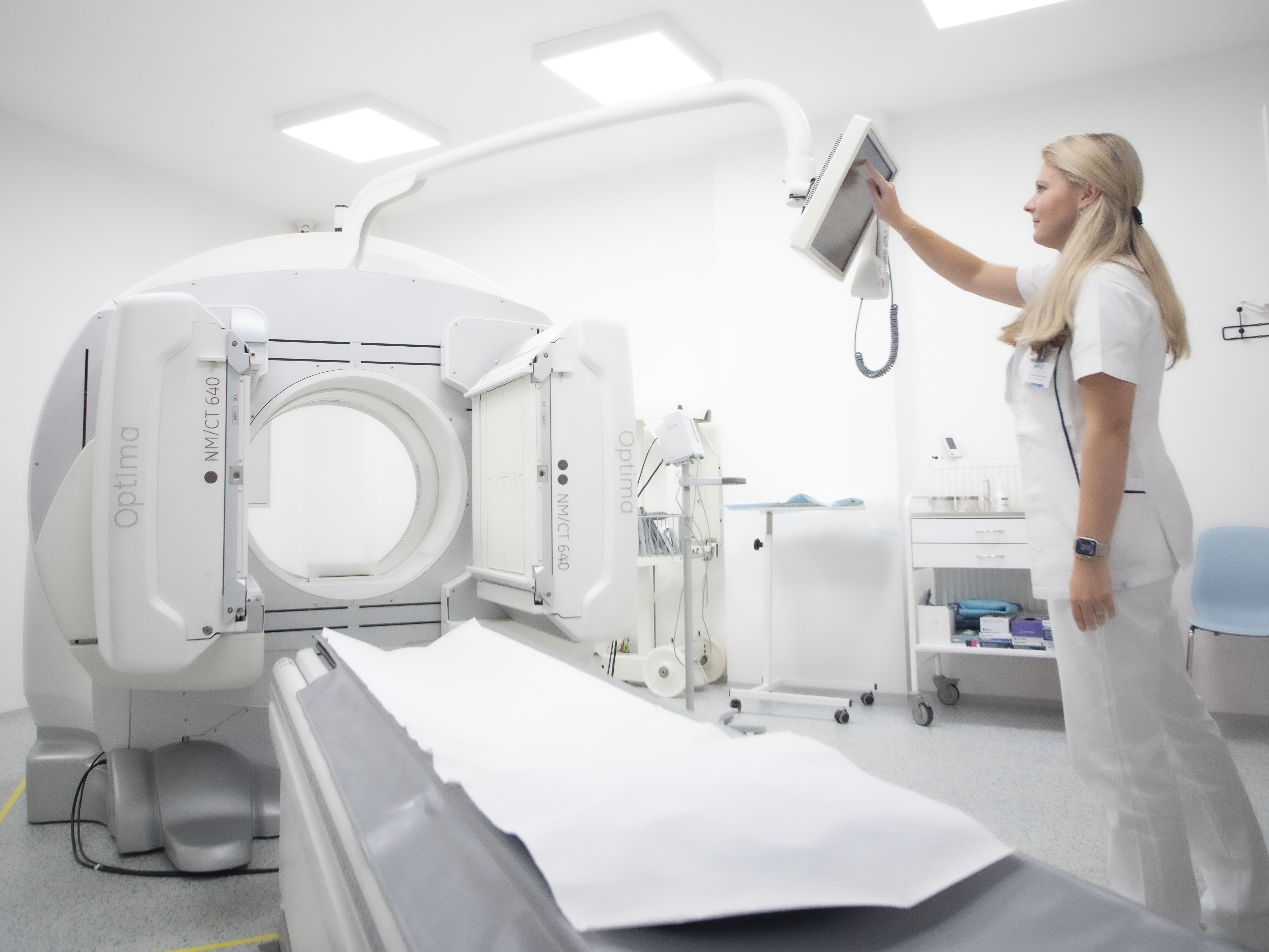
- a modern SPECT/CT device
- an experienced team of doctors and radiology assistants
- sophisticated imaging methodology → high-quality data for quantification
What specifically can DaTQUANT evaluate?
🧠 1. Specific Binding Ratio (SBR)
Basic numerical indicator of dopaminergic transporter reduction.
🧠 2. Asymmetry between hemispheres
Important for Parkinson's disease, which is typically asymmetrical.
🧠 3. Age-based percentile
Allows the output to be placed in the context of the population.
🧠 4. Qualitative maps of radiopharmaceutical distribution
Visualise the degree of signal loss.
🧠 5. Trend analysis during repeated examinations
Useful for monitoring disease progression.
When should a neurologist consider DaTSCAN + DaTQUANT examinations?
- Uncertainty between Parkinson's disease and ET
- Atypical tremor
- Rapid progression, atypical course
- suspicion of drug-induced parkinsonism
- differential diagnosis of NPH, MSA, PSP
In all these situations, objective quantification is a major benefit.
Conclusion: Why is DaTQUANT the future of Parkinson's disease diagnostics?
DaTQUANT fundamentally advances the interpretation of DaTSCAN SPECT:
- increases accuracy
- eliminates subjectivity
- supports early detection of dopaminergic deficiency
- helps resolve borderline or atypical cases
Thanks to the combination of experienced specialists and modern quantification technology, PMCD provides patients with one of the most accurate diagnoses of movement disorders in the Czech Republic.
