
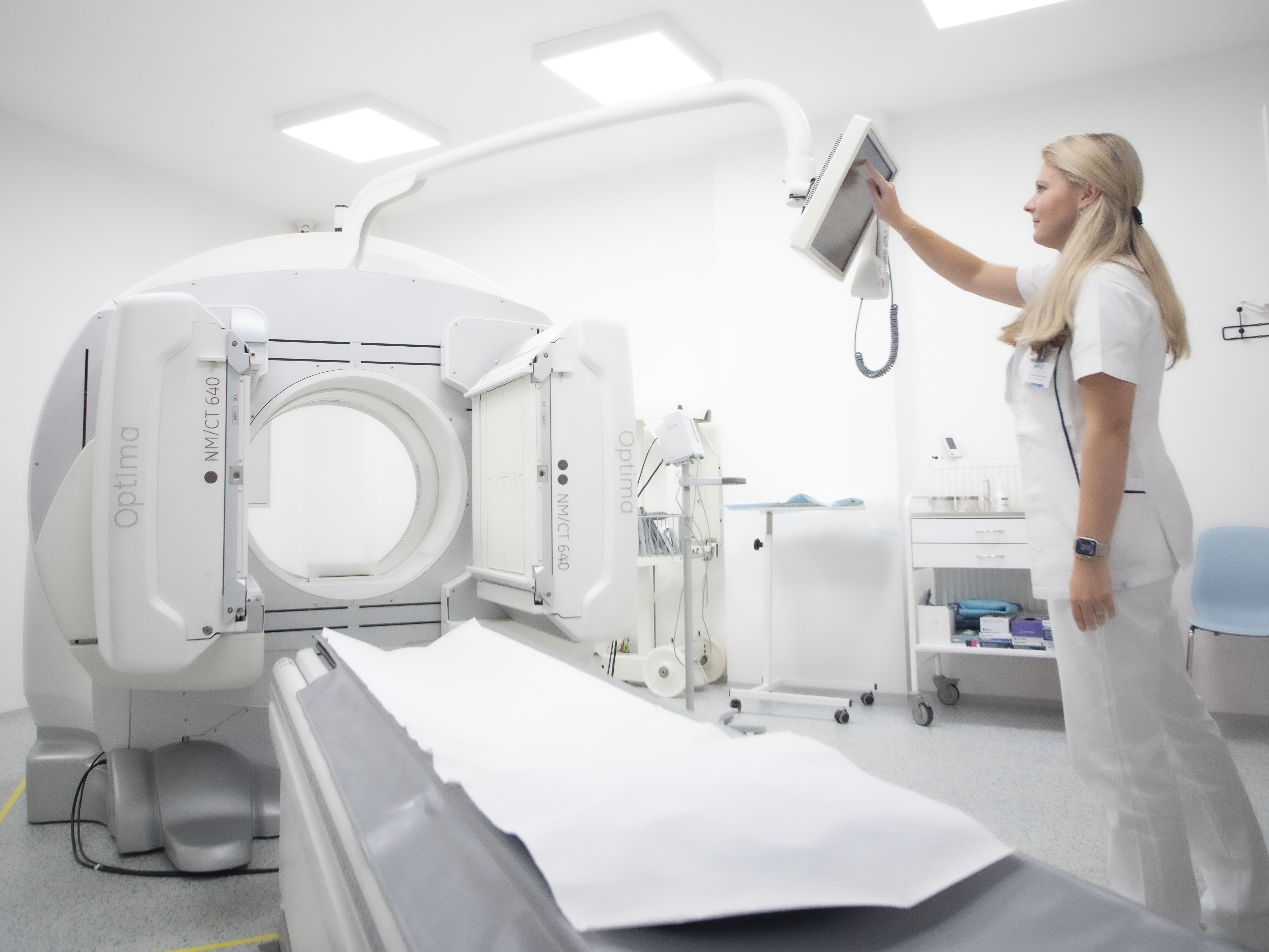
What is skeletal scintigraphy and when is it performed: modern diagnostics of bone diseases
Introduction: Why is it important to have your bones examined in time?
The diagnosis of bone diseases is one of the key areas of modern nuclear medicine. Whether it is suspected metastatic bone involvement, chronic pain, injuries or inflammatory diseases, skeletal scintigraphy is one of the most sensitive imaging methods that can detect even small pathological changes.
While X-rays and CT scans show anatomical changes, scintigraphy monitors bone remodelling, which changes before the structure does.
This makes it indispensable for patients with cancer, in orthopaedics, and in cases of suspected osteomyelitis (inflammation), stress fractures, or joint inflammation and pain.
The principle of skeletal scintigraphy: how does the radiopharmaceutical work in the bones?
The examination uses a radiopharmaceutical containing 99mTc bound to diphosphonates (MDP, HDP, etc.). These substances are selectively deposited in bone tissue in areas of:
- increased bone remodelling
- inflammation
- trauma
- new bone formation metastatic lesions
The radiopharmaceutical emits low-energy gamma radiation, which is captured by a gamma camera. This produces an image of bone metabolism.
When is skeletal scintigraphy performed? Main indications
1. Oncological examinations – suspected metastases
Typically for tumours:
- breast
- prostate
- lung
- kidney
- thyroid
Scintigraphy can detect lesions even in the early stages, often before they show up on a CT scan.
2. Chronic or acute bone pain, especially after injuries
If the pain persists but the X-ray is negative, scintigraphy can detect:
- stress fractures
- stress reactions
- aseptic necrosis
- Paget's disease
3. Inflammation — osteomyelitis
Especially in patients with diabetic foot or after orthopaedic surgery.
4. Rheumatology
Evaluates activity:
- arthritis
- sacroiliitis
- enthesopathy
Three-phase skeletal scintigraphy: when and why is it performed?
Three-phase examination allows for a more detailed analysis of blood flow and metabolic activity in the area of interest.
Phase 1 – Perfusion (vascular) phase
Immediately after administration of the radiopharmaceutical. Monitors the blood supply to the scanned area.
Phase 2 – Soft tissue phase
2–5 minutes after administration. Reflects the rate of absorption into soft tissues.
Phase 3 – Bone phase
2–4 hours. Changes in the bones are displayed.
Three-phase scintigraphy is the best method for assessing:
- inflammation
- infections around implants (endoprostheses)
- stress fractures
How does the examination work in practice?
1️⃣ Administration of radiopharmaceutical into a vein
2️⃣ Waiting 2–3 hours for distribution to the bones
3️⃣ Scanning with a gamma camera – whole body and targeted
4️⃣ Painless, no preparation required
5️⃣ No restrictions after the examination
The patient leaves with their normal routine. When administering the radiopharmaceutical, it is necessary to follow the recommended routine when in contact with sensitive populations.
What does scintigraphy reveal in specific diagnoses?
Metastatic involvement
Typically, foci with high accumulation of radiopharmaceuticals.
Osteoporotic fractures
Unlike tumours, they have typically irregular edges.
Osteoarthritis
Increased accumulation in weight-bearing joints.
Osteomyelitis
Increased uptake of radiopharmaceuticals in all three phases.
Advantages of the examination
- High sensitivity
- Overview of the entire skeleton
- Quick and accessible examination
- low radiation exposure
Conclusion
Skeletal scintigraphy is one of the cornerstones of modern nuclear medicine. It enables early detection of metastases, inflammation and injuries and plays a key role in monitoring cancer patients.
